Current MRSEC-Affiliated Students and Postdoctoral Researchers
 UC San Diego MRSEC deeply values its participant engagement in and contribution to non-research, Center-sponsored education and outreach (E&O) activities in materials science and engineering. The benefits are not only external; beyond enjoyment and satisfaction derived from impacting the lives of others, trainees can expect to gain new perspectives and practice in science communication. To convey our commitment to these efforts, all MRSEC trainees are expected to contribute at least 32 hours per year to MRSEC-specific E&O activities. These efforts are endorsed by MRSEC faculty advisors, who also take part.
The Center offers a wide range of engagement opportunities throughout the academic year and summer period, which members can select from based on their preferences, interest, and unique strengths. Examples of engagement activities include co-facilitating a public-facing table/booth exhibit on or off campus, assisting with community outreach events, preparing supplies and materials for demos and hands-on activities, and presenting about MRSEC-supported research at UC San Diego or at local K-12/high schools, among others.
****
For a list of specific current activities and initiatives you can get involved in, click here. For additional information, contact Janka Bond at j2bond@ucsd.edu. UC San Diego MRSEC trainees can report their hours of participation in UC San Diego MRSEC education and outreach effort using this online log.
Travel Policies: Reimbursement for MRSEC Trainees for Scientific Meetings/Research Trips and Conferences
UCSD MRSEC Policies for trainee travel to professional meetings, presenting MRSEC research at a conference, or trips to other sites to do MRSEC-specific research are as follows: Subject to available funds, regular MRSEC trainees can get reimbursed for registration, hotel, and airfare for a professional meeting. The traveler must first get approval from MRSEC Director or Assistant Director prior to booking travel and/or creating travel request in Concur.
In most instances, the funded individual must give a presentation (poster or oral) that cites MRSEC funding. For a trip to another site to do MRSEC-specific research, it is expected that the product of that research (i.e., publication, talk, poster) will cite MRSEC for either full or partial support. Generally, the amount that MRSEC is willing to spend on each trip will be specified at the time that the travel request is granted.
- Travel expenses must comply with UC San Diego travel policy. Click this link to learn more about UC San Diego Travel Policy and Guidelines.
- Travel funds are intended for funded trainees. If the student is a MRSEC student affiliate (not a funded trainee) MRSEC generally does not support meeting expenses. Exceptions include mentors of RIMSE summer school program, and other MRSEC-sponsored educational activities where the meeting presentation can clearly be demonstrated to be relevant to the MRSEC.
- If the meeting is exclusively a training/professional development activity that does not involve a presentation by the trainee, a request for exception can be submitted. The request should specifically justify the importance of the meeting participation to the trainees’ professional development in the context of MRSEC research and/or education goals.
Acknowledgment of MRSEC support must be included in the presentation. To get reimbursed for a scientific or technical professional meeting or conference, the trainee must submit to MRSEC staff the poster or presentation that they gave at the meeting and the acknowledgements slide that was presented at the meeting must state:
“This research was primarily (partially) supported by NSF through the UC San Diego Materials Research Science and Engineering Center (UC San Diego MRSEC) DMR-2614051.”
And/or if the work used MRSEC supported facilities (instrumentation or computation):
“The authors acknowledge the use of facilities and instrumentation supported by NSF through the UC San Diego Materials Research Science and Engineering Center (UC San Diego MRSEC) DMR-2614051”
One trip-one publication rule: The intention of travel funds is to support the research in a manner that is consistent with the level of productivity of the researcher. So it is assumed that each meeting trip will result in an archival, peer-reviewed research publication (not just an extended abstract); multiple meetings to present on the same publication are not supported.
We recognize that some labs need to travel to facilities around the country to conduct their research (e.g., to a National Lab in order to collect data using a national resource such as a synchrotron). For such research-related trips, the one-trip-one-publication rule does not apply.
Professional Development & Career Resources for MRSEC Trainees
 San Diego Nanotechnology Infrastructure (SDNI)
SDNI C.E.N.T.E.R (Center of Excellence for Nano Technology Educational Resources)
C.E.N.T.E.R. is the Education arm of the SDNI and aims to provide guidance and assistance to educators (K-12, Community Colleges, and 4-years Universities) desirous of developing nanotechnology curriculum and providing education in the field. In the process, they have been and will continue to be very thorough about ensuring the alignment of nanotechnology content with the Next Generation Science Standards for K-12 education. The SDNI outreach program’s goal is to facilitate the development of Nanotechnology curriculum and its integration to the entire K-12 and Community College education systems across California by 2025 (The California NanoTech 2025 Project). In order to achieve this ambitious goal, SDNI intends to create strategic alliances with teachers and administrators operating in schools, community colleges, school district offices, and county offices of education.
 IDEA Engineering Student Center
Current Graduate Students Resources
Engineering Graduate & Scholarly Talks: Series of academic, professional, and technical training workshops open to all graduate and postdoctoral engineering students at the Jacobs School of Engineering.
Fridays, 12:00 pm to 1:00 pm (Fall 2021 Schedule is being finalized)
POC: Sinai Kota, sicota@eng.ucsd.edu
UC San Diego Career Center
Graduate Student Lunch & Learn
Alumni 101 Speaker Series: discussions on networking, job and internship searching, mentorship, and other topics
POC: Giulia Hoffmann, Senior Associate Director, UC San Diego Career Center
gkhoffmann@ucsd.edu | 858.534.0141 | gradcareers.ucsd.edu
Students and Postdoctoral Researchers from UC San Diego and External Institutions
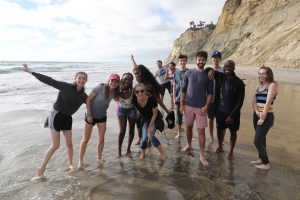
Students and postdoctoral researchers interested in getting involved in UC San Diego MRSEC projects are welcome to:
- Submit an application to participate in the Research Immersion in Materials Science & Engineering (RIMSE) Spring Break Experience, or in one of the Research Immersion in Materials Science & Engineering (RIMSE) Summer Schools. Details on how to apply can be found on our website.
- Contact any of the of MRSEC-affiliated faculty regarding opportunities for research collaboration in their laboratories. More information can be found on the Research - IRG1 and Research - IRG2 webpages.